Consultations
Rejuran in Korea: Sessions, Downtime and How a Doctor-Led SVIP Clinic Works
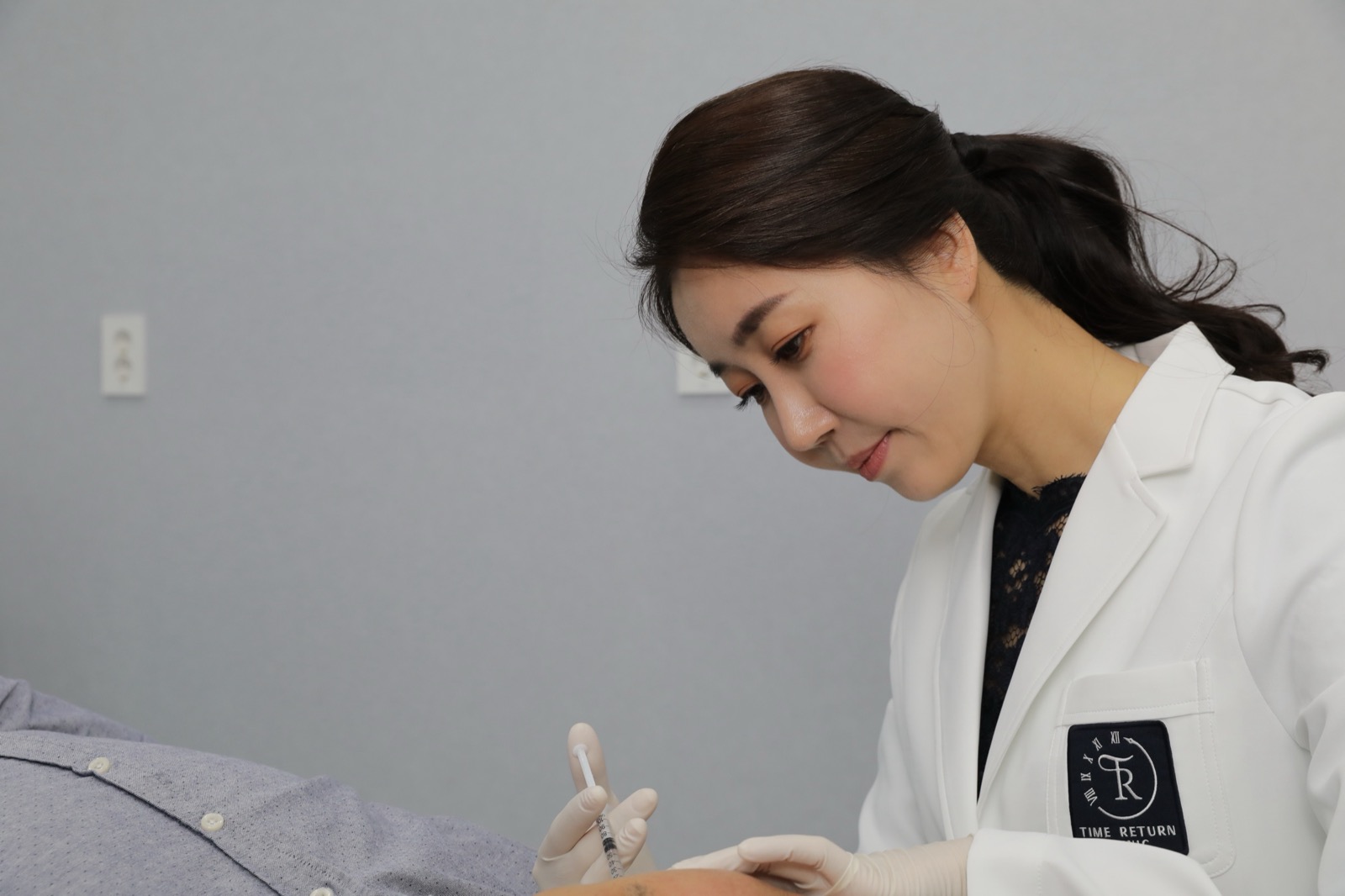
Rejuran is an injectable skin booster made by PharmaResearch from polynucleotide (PN) derived from salmon DNA. KCODI puts the usual course at about three sessions, two to four weeks apart, and Time Return Clinic (타임리턴의원) in Yeouido, Seoul, says the small bumps it leaves usually settle in about 1–3 days.
What is Rejuran, and what does the research say?
Time Return's Rejuran Healer page describes the product as PN from salmon DNA. It says that in laboratory studies PN and the related PDRN are linked to adenosine A2A receptor signalling and to more active fibroblasts and matrix production, and it adds that human evidence is still more limited.
Placement is the second theme. The same page notes that the dermis is only about 0.5–2 mm thick depending on the area, and cites cadaver and ultrasound work showing that needle length and angle decide whether the product lands inside the dermis or below it.
It also cites a 2024 survey of 235 Korean dermatologists, many of whom used a 33G needle and serial puncture. The clinic keeps these published statements apart from its own technique and states that no technique guarantees a result.
How many sessions do you need, and how far apart?
KCODI's overview says Rejuran is priced per session and the usual course is about three sessions, two to four weeks apart. It describes one session as giving a modest improvement in hydration and texture that builds over about four weeks, with the fuller effect coming from the course.
Time Return does not commit to a number in advance. Its FAQ says the doctor sets the number and spacing after examining skin thickness and goals, and that it does not promise a fixed number before that assessment.
The clinic does describe a typical sequence: better texture and oil–moisture balance after the first session, more elasticity and softer fine lines after the second, natural lifting and facial volume after the third, and barrier regeneration after the fourth. These are the clinic's descriptions, not a forecast for your skin.
What downtime should you expect?
Time Return describes small raised bumps at the injection points as a common, short-lived reaction while the skin absorbs the product. Its aftercare notes break down like this:
Bumps at injection points: usually settle in about 1–3 days.
Mild redness: usually about 1–2 days.
Makeup: light makeup only after 24 hours.
Sauna, steam rooms, hot baths and hard exercise: avoid for about the first week.
Alcohol and smoking: the clinic advises avoiding them for 1–2 weeks.
KCODI adds that pinpoint bruises can last up to a week and that most people go out the next day with a mask, so it suggests booking early in a trip rather than the day before an event.
Time Return's FAQ lists the general risks of any injection or laser treatment: bleeding, infection, inflammation, swelling or redness.
How does a doctor-led SVIP clinic approach Rejuran?
Asked whether Rejuran is the same at every clinic, Time Return's FAQ answers that the product is the same genuine Rejuran, and that what changes is how accurately it is delivered to the dermis. At this clinic, it says, the doctor who consults also injects by hand.
Time Return presents itself as a Rejuran SVIP clinic in Yeouido, and its homepage describes a plasma five-step anesthesia system called 5A+, with levels from 0+ to 5+, where standard numbing cream equals level 0+. The same page says consultations are held by the director in person, in private single rooms, with interpreters on site.
The clinic says PharmaResearch, the maker, selected it as a Rejuran SVIP grade clinic, and it lists a 2026 Rejuran BLACK Membership. It labels its case figures as its own count and says results vary by individual.
Two doctors are named on its doctors page: Dr. Kim Yoo-ju, founder and medical director, listed as a Rejuran clinical advisor and holder of a collagen-film thread lifting patent, and Dr. Kim Dong-hu, director of the lifting center and a family medicine specialist.
Time Return Clinic at a glance
Address: 71 Yeouinaru-ro, Yeongdeungpo-gu, Seoul (Suite 101 on 1F, Suite 305 on 3F).
Subway: Yeouido Station (Lines 5 and 9), Exit 4, about 4 minutes on foot.
Airport bus: the Korea Exchange stop is right in front of the clinic.
Hours: Monday to Friday 10:00–20:00, Saturday 10:00–16:00, closed Sundays and public holidays.
Booking: message the clinic with your skin concern and travel dates, and it replies with available times.
What should you ask before you book?
Time Return's own page suggests questions for any Rejuran clinic, and they work as a checklist:
How do you control pain, and can I choose the numbing level?
Does the doctor who consults also inject, and is depth adjusted point by point?
What should I avoid afterwards, for how long, and who do I contact if something worries me?
What is the price per session in KRW, and which product and volume does it cover?
For price context, KCODI's guide to Rejuran in Korea gives a typical Seoul range of ₩250,000–₩600,000 per session, marked as a market estimate, not a quote. KCODI is a coordination service paid by clinics; it assigns your own medical interpreter free and says you never pay a deposit before you hold a written, itemised quote.
FAQ
Is Rejuran the same at every clinic? — The product is the same. Time Return says what differs is how accurately it is placed in the dermis.
Does Rejuran hurt? — KCODI says it stings more than botox. Time Return offers 5A+ numbing from level 0+ to 5+, and pain tolerance varies.
Can I have Rejuran with a fish allergy? — Tell the doctor first. KCODI notes that many clinics avoid it in that case and that the doctor can suggest non-fish skin boosters instead.
When can I wear makeup again? — Time Return's aftercare notes allow light makeup after 24 hours.